Sunscreen Manufacturing in China: Format, SPF and Market Rules
A sunscreen brief in China comes down to three decisions: the format, the SPF level and the rules of the market you ship to. SPF30 blocks about 97% of UVB and SPF50 about 98%, so the headline gap is smaller than most new brands expect. Format and destination rules usually decide the launch long before the last point of SPF does.

Key takeaways
- SPF30 blocks about 97% of UVB; SPF50 blocks about 98%.
- Four common formats: lotion, stick, spray and gel.
- In the United States, sunscreen is handled as an OTC drug, and a Broad Spectrum claim needs a critical wavelength of 370 nm or more.
- ODM runs on an existing formula in 4 to 8 weeks; OEM with development takes 3 to 6 months.
Format comes before the SPF number
Where the product will be used decides the format long before anyone argues about the figure on the front of the pack. A daily face product is usually a lotion or a gel, a beach product is usually a spray, and a pocket item is usually a stick. Each choice pulls a different base, filling line and stability profile, so a late format switch costs far more than a late shade change.
Bring two formats to the first sample round when the range is still open. Comparing a lotion against a spray at the same SPF tells you more in three weeks than three months of internal debate, and it protects the launch date if one format turns out to be awkward to fill at the pack size you want.
What SPF30 and SPF50 really change
SPF is a UVB measure, and it rises slowly at the top of the scale. SPF30 blocks about 97% of UVB and SPF50 about 98%. The two numbers look close because they are close: the protected share moves by one point while the share that gets through falls by a third. That is why the format, the water resistance and the reapplication message often matter more than the step from 30 to 50.
PA grading covers UVA and is written separately. The client's sunscreen pages describe PA++ at 4 to 7 hours, PA+++ at 8 hours or more, and PA++++ as top protection lasting more than 16 hours. A brief that names only SPF leaves half of the protection story untold, and buyers in Asia will notice the gap first.
The four formats and where they fit
Lotion carries the widest range of actives and is the easiest to test, which keeps it the default for face and body. A stick wins on portability and precise application near the eyes and lips, but it needs a firm, low-migration base. Spray is quick on large areas and the hardest to fill evenly. Gel suits oily skin and hot climates but limits how much active the base can hold.
None of the four is better in the abstract. A sports line built around sweat resistance will usually start from a lotion, while a travel line will start from a stick or a small spray. Match the format to the shelf and the climate, then let the SPF target follow rather than the other way round.
| Format | Where it fits | Main trade-off |
|---|---|---|
| Lotion | Face and body, daily use | Widest active range, slower to apply |
| Stick | Travel, eyes and lips | Portable and precise, firm base required |
| Spray | Large areas, beach use | Fast coverage, hardest to fill evenly |
| Gel | Oily skin, hot climates | Light feel, lower active ceiling |
Market rules decide more than the formula
The destination sets the paperwork. In the United States, sunscreen sits inside an OTC drug framework, which fixes the actives that may be used, how SPF must be tested and how the label must be worded. A Broad Spectrum claim also needs a broad-spectrum test, and the client's page refers to a critical wavelength of 370 nm or more. None of that is optional, whatever the formula does on a swatch.
This is where a buyer learns the difference between a quick private-label run and a genuine launch. The actives list, the test protocol and the label copy should be settled before the first bulk batch, because a change after filling means new artwork, new tests and a wasted run. An experienced sunscreen manufacturer that ships to several regions will usually keep these checklists per market.
Worked example: reading the SPF chart
The chart plots the share of UVB each level blocks. Take SPF30 at 97% and SPF50 at 98%. The share that reaches skin is 100 - 97 = 3% at SPF30 and 100 - 98 = 2% at SPF50. The fall from 3% to 2% is (3 - 2) ÷ 3 = 0.333, so one chart point is roughly a one-third cut in the UVB that gets through. The time figures move further: 30 × 15 = 450 minutes at SPF30 and 50 × 15 = 750 minutes at SPF50, a 300-minute gap.
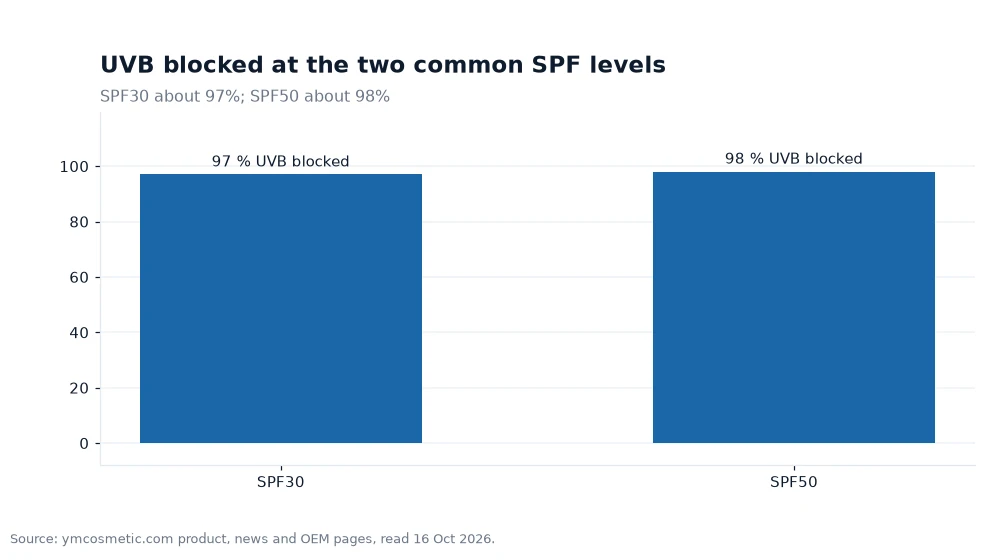
Two numbers matter most on the chart. The 2% and 3% transmitted share shows why SPF50 is not twice as strong as SPF30, because the blocked share only moves from 97% to 98%. The bigger practical difference is the 450 against 750 minute window, and that window is what drives the reapplication advice printed on the pack.
Lead times: ODM, OEM and stability testing
Timelines depend on whether the formula already exists. An ODM project that uses an existing base and adjusts fragrance or skin feel is quoted at 4 to 8 weeks. An OEM project that develops a new formula, tests it and then produces it is quoted at 3 to 6 months. Stability and compatibility reports take 3 to 6 months on their own, so they usually run alongside development rather than after it.
Ingredient sourcing and packaging lead time move the finish date as much as the laboratory does. A pump that has to be tooled, or an active with a long import window, can add weeks that no amount of bench work removes. Ask for the critical path rather than the total, and book the pack before the batch.
Capacity, packing and a first order
Capacity answers a different question: can the partner absorb your forecast without pushing your slot? Yunmei runs an OEM/ODM one-stop service and publishes 160 million units a year, 200,000 units a day and 35 automated production lines. Those figures describe a plant built for volume, which matters if you plan to reorder inside the same season rather than waiting a year.
Filling quality is the part a buyer can check on the sample. The client's pages list filling accuracy of plus or minus 0.2 ml with full weight verification, an on-time delivery figure of 98.5% and a 72-hour response target. Compare the sample you approve against the bulk tolerance before you sign, and read how the plant runs on the OEM and ODM services page.
Frequently asked questions
Is SPF50 twice as strong as SPF30?
No. SPF30 blocks about 97% of UVB and SPF50 about 98%, so the transmitted share falls from 3% to 2% rather than halving. The larger practical difference is the time window, about 450 minutes at SPF30 against 750 minutes at SPF50.
How long does an OEM sunscreen project take?
An OEM project with new development is quoted at 3 to 6 months, including research, testing and production. Stability and compatibility reports take 3 to 6 months on their own and usually run alongside the development work.
Which formats can be ordered?
The client's sunscreen pages list lotion, stick, spray and gel, with examples such as SPF50 Sunscreen Lotion, Sweatproof 50 SPF Sunscreen and Waterproof Sunscreen.
Choosing a partner for the first sunscreen run
Write the format, the SPF target and the destination rules into one short brief before you ask for quotes. From there, compare partners on the points that are hard to change later: the actives they can source, the tests they can run in house, and the delivery window they hold when the season peaks. A useful next step is to read the SPF30 against SPF50 comparison and then book samples in two formats.
The figures used were taken from the company's published product pages on 16 Oct 2026.[1]