A Repair Bill in a Bad Week: Borrowing Against Bitcoin at 469 TH/s
A failed power supply does not wait for a payout date. At 469 TH/s the rig clears $17.11 a day once the listed 4% on the block-reward component is removed, so a $900 repair eats 53 days of output if the coins are sold to pay for it. Pledging BTC you already hold turns that one-off sale into a repayment schedule priced at $84,692 a coin.

Key takeaways
- 469 TH/s produces 0.0002104 BTC a day, or $17.82 gross and $17.11 net of the listed 4%.
- A $900 repair equals 52.6 days of net output at that hashrate, which is why selling coins feels expensive.
- Collateral size should be set so that a lower BTC price does not force a liquidation at the worst moment.
- The full sequence is Add Collateral, Apply for Loan, Receive Loan, Repay Loan, Redeem Collateral.
The bill arrives before the payout does
Repair costs are quoted in local currency and settled in days, while mining income arrives in small coin increments. That mismatch is the whole problem. A transformer, a control board or a pair of fans can cost more than a month of output, and the invoice usually lands in the same week that the machine stops producing. Selling BTC to cover it is simple, but it converts a temporary cash gap into a permanent reduction of the holding.
Pledging part of that holding is the other route. The coins stay on the platform as security rather than leaving the account, and the cash borrowed is repaid from future output. The decision is not whether borrowing is cheaper in the abstract; it is whether the daily output can carry the repayment without forcing a second sale later. That question can be answered with a calculator and a calendar.
One warning belongs here. A loan against a volatile asset is a leveraged position, and leverage magnifies a price fall as well as a price rise. The point of the exercise is to cover a repair, not to enlarge a bet, so the borrowed amount should stay close to the invoice and no further.
What the machine has to cover each day
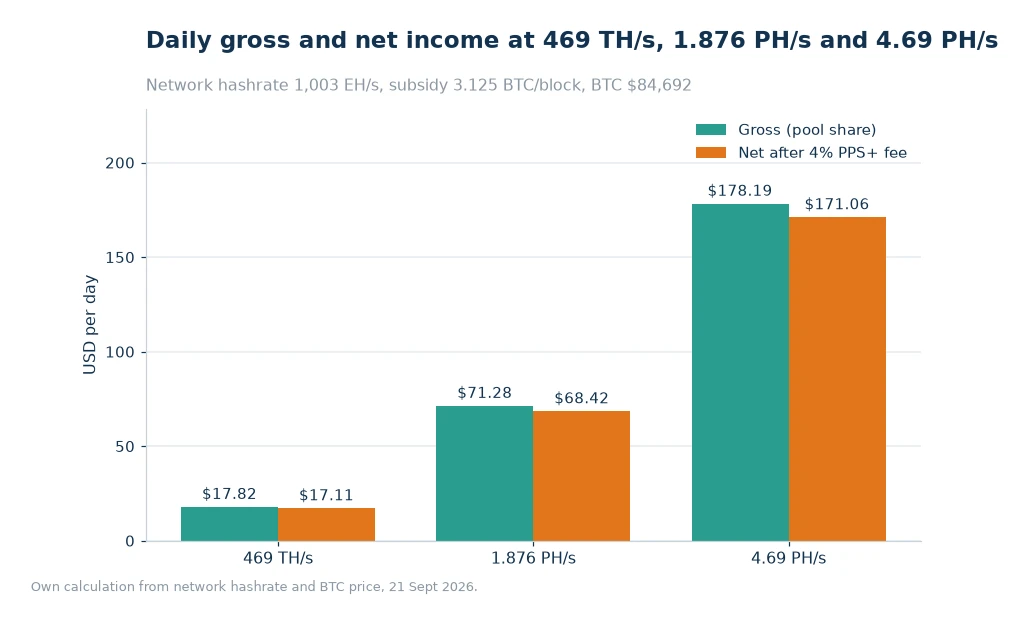
Start with the output side, because it sets the ceiling on any repayment plan. The chart below uses a network hashrate of 1,003 EH/s, a subsidy of 3.125 BTC per block and 144 blocks a day, which together put 450 BTC into the market daily. Divide that by the network total and multiply by your own hashrate, and the daily coin figure appears.
At 469 TH/s the result is 0.0002104 BTC, worth $17.82 before fees. The listed 4% applies to the block-reward component, which leaves $17.11. Scale the same arithmetic to 1.876 PH/s and the net becomes $68.42; at 4.69 PH/s it reaches $171.06. Those three figures are the ones to hold against a repair bill, a loan instalment and the power bill at the same time, because all three compete for the same dollars.
Sizing collateral so a price drop does not force a sale
Every platform has its own required ratio between the pledged coin and the cash advanced, and that ratio is the number to ask about first. Whatever it is, the cushion above it is yours to choose. A borrower who pledges exactly the minimum leaves no room for a BTC price fall, and a margin call at that point tends to arrive when the repair is still unpaid.
A practical approach is to work backwards from the worst case you are willing to accept. Decide the lowest BTC price at which you would still want to keep the position, then check whether the collateral would survive it. If the answer is no, either borrow less or pledge more. Both moves shrink the loan, which is the intended effect.
The term matters as much as the size. A loan that matures before the repaired machine is back on the wall is a scheduling error, not a financing decision. Match the maturity to the repair lead time plus a few weeks of production, and the repayment comes out of earnings rather than out of the coin holding.
The route from collateral to cash
The product is built as a sequence rather than a single click, and knowing the order avoids surprises. Collateral-Pledged Loans begin with Add Collateral, where coins are locked to the position. Apply for Loan sets the amount and term. Receive Loan puts the cash in the account. Repay Loan reduces the balance, and Redeem Collateral releases the coins once the obligation is cleared.
Two details catch people out. The first is that redeeming too early is not possible, so the coin you pledge should be coin you can live without for the term. The second is that repayment from mining output requires the payout address to keep working; if the machine stays down longer than expected, the plan needs a fallback. Read the fee page before signing so the cost of the loan is compared with the cost of simply selling a little BTC.
The ViaBTC Crypto Loan page lists the current terms, and the multi-currency wallet is where the pledged balance and the borrowed funds both sit. Checking both in one place makes the position easier to read than watching two separate screens.
| Hashrate | Daily gross | Daily net | Days to cover $900 |
|---|---|---|---|
| 469 TH/s | $17.82 | $17.11 | 52.6 |
| 1.876 PH/s | $71.28 | $68.42 | 13.2 |
| 4.69 PH/s | $178.19 | $171.06 | 5.3 |
Worked example
Take the single 469 TH/s rig and follow the arithmetic from network data to the repayment calendar.
- Start from the daily network output of 450 BTC and divide by 1,003,000,000 terahashes: each terahash accounts for 0.00000044865 BTC.
- At 469 TH/s: 469 × 0.00000044865 = 0.00021042 BTC a day, rounded to 0.0002104.
- Value it at $84,692: 0.00021042 × 84,692 = $17.82 gross.
- Remove the listed 4% on the block-reward component: 17.82 × 0.96 = $17.11 net.
- A $900 invoice divided by 17.11 = 52.6 days of output.
- At 1.876 PH/s the net is four times larger, $68.42, so the same invoice takes 13.2 days.
- At 4.69 PH/s it is ten times the single rig, $171.06, and the bill is covered in 5.3 days.
The comparison that matters is not the 5.3-day figure; it is the gap between 52.6 days and the loan term. If the term is shorter than the time the machine needs to earn the money back, the repayment has to come from somewhere else, and the loan has quietly become a sale with extra steps.
Frequently asked questions
How much does 469 TH/s earn in a day?
At a network hashrate of 1,003 EH/s and a subsidy of 3.125 BTC per block, 469 TH/s earns 0.0002104 BTC a day. That is $17.82 at $84,692 per BTC before fees, and $17.11 after the listed 4% on the block-reward component.
Is borrowing against BTC better than selling it for a repair?
It depends on whether the daily output can carry the repayment inside the loan term. Selling removes the coins permanently, while pledging keeps them and adds an obligation; if 52.6 days of output at 469 TH/s does not fit the term, selling a smaller amount is the cleaner choice.
What happens to the pledged coins during the loan?
They stay locked as security until the balance is cleared, which is why Redeem Collateral comes last in the sequence. Pledge only coin you can leave untouched for the full term, and check the required ratio before choosing the amount.
Set the repayment date before you click
Write three dates on one line: the day the repair is finished, the day the first repayment is due and the day the term ends. If the middle date falls before the first, the plan is sound. If it falls after, borrow less or extend the term. The Profit Calculator gives the daily output figure for the repaired machine at current difficulty, and that figure is the numerator in every version of this decision.
Nothing about a repair loan changes the hashrate or the network. It changes who holds the coins while the machine is fixed. Keeping that distinction clear is what stops a short-term cash gap from turning into a long-term position change.
Sources: the ViaBTC loan, wallet and fee pages for product terms and the listed 4%[1]. Inputs checked 21 Sept 2026: 1,003 EH/s network hashrate, 132.76 T difficulty, 3.125 BTC per block and 144 blocks daily, with BTC at $84,692. Published 24 Oct 2026; all output figures are arithmetic on those inputs at continuous uptime.